


Table of Contents
- What to Look for in Christian Jewelry Companies
- Handcrafted Christian Jewelry: Why Artisan-Made Matters
- Faith-Based Jewelry for Women: Styles for Every Expression
- Meaningful Religious Gifts for Every Milestone
- Caring for Your Faith-Based Jewelry: Maintenance That Preserves Meaning
- How to Evaluate Christian Jewelry Companies Before You Buy
- Frequently Asked Questions
Last Updated: September 28, 2026
What to Look for in Christian Jewelry Companies
The best Christian jewelry companies combine durable materials, transparent sourcing, and designs that carry genuine spiritual meaning. Gifts of Grace Designs approaches this guide from a maker's perspective.
Materials That Last: Stainless Steel, Sterling Silver, and 14k Gold
Material choice is the single biggest predictor of how long a piece survives daily wear. Stainless steel resists tarnish and suits everyday use, sterling silver offers a softer, classic finish, and 14k gold delivers lasting value for milestone gifts.
Each has trade-offs:
- Stainless steel, hypoallergenic, tarnish-free, best for daily wear and active lifestyles
- Sterling silver, elegant and traditional, but needs polishing to stay bright
- 14k gold, the most durable precious metal, ideal for baptism or confirmation gifts meant to last a lifetime
Ethical Sourcing and Manufacturing Transparency
Transparency separates serious Christian jewelry companies from drop-shippers. Ask where the stones come from, who assembles each piece, and whether the brand can describe its supply chain without vague language.
Responsible Jewellery Council guidance on ethical supply chains
Handcrafted Christian Jewelry: Why Artisan-Made Matters
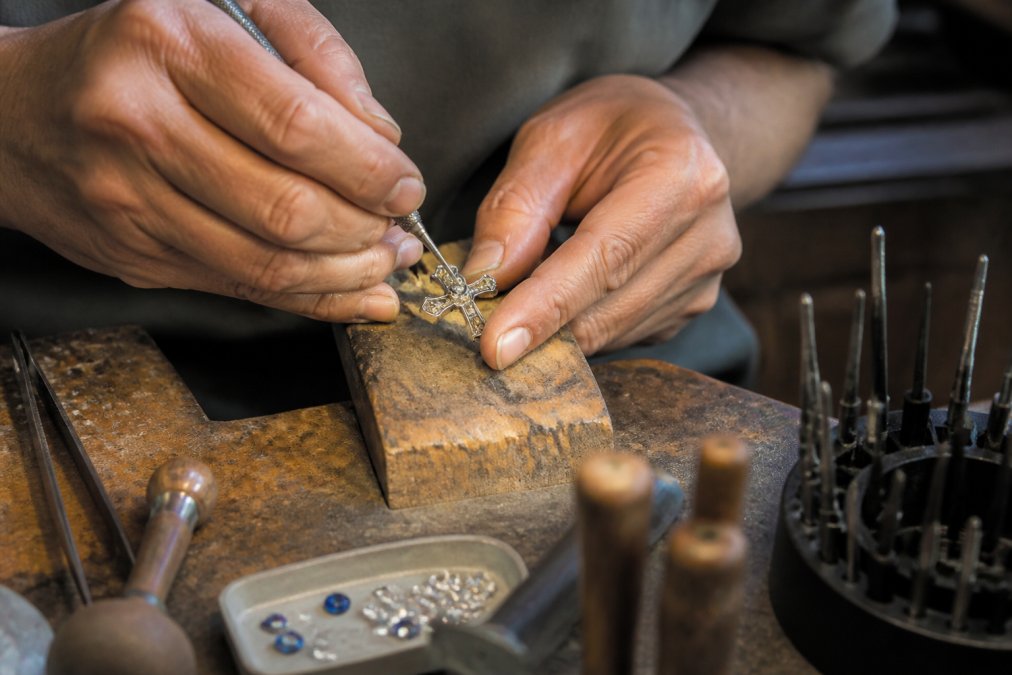
Handcrafted Christian jewelry carries detail that machine-stamped pieces cannot replicate. An artisan sets each stone by hand, checks the finish, and adjusts the design so the piece sits correctly against the skin.
Faith-Based Jewelry for Women: Styles for Every Expression
Faith-based jewelry for women ranges from bold statement crosses to subtle, everyday reminders of scripture. The right choice depends less on the piece itself and more on where you'll wear it, how you dress, and what your tradition emphasizes. Most guides stop at "delicate or bold." The more useful question is: what actually works in your daily life?
Styling by Setting: Professional, Casual, and Worship
The same cross reads differently depending on context. A few patterns hold up across most wardrobes:
- Professional settings. A single pendant on a 16-18 inch chain sits at the collarbone, tucks under a blouse when needed, and reads as understated rather than declarative. Small crosses, mustard seeds, and ichthys charms work well here because they're recognizable to those who know and quiet to those who don't.
- Casual and everyday. This is where layering earns its keep. A short chain (16 inch) with a small symbol plus a longer chain (20-24 inch) with a slightly larger pendant creates depth without clutter. Stick to one metal tone per stack unless you're deliberately mixing, mixed metals look intentional or accidental, rarely in between.
- Worship and formal occasions. A single, slightly larger cross or dove on a 20-inch chain reads clearly from a distance and photographs well for baptisms, confirmations, and weddings. This is also the setting where 14k gold or polished sterling silver outperforms brushed stainless steel visually.
Denominational and Cultural Considerations
Christian traditions emphasize different symbols, and matching the piece to the wearer's background often matters more than the design trend of the moment:
- Catholic and Orthodox wearers frequently gravitate toward crucifixes (with the corpus) rather than plain crosses, plus Marian medals and saint medallions. Layering a small medal with a cross is a long-standing practice, not a new trend.
- Protestant traditions tend to favor plain crosses, ichthys, and scripture-engraved pieces. Mustard seed and anchor motifs appear often because they tie directly to preached themes.
- Evangelical and non-denominational wearers often choose verse-reference pendants or minimalist symbols that open conversations rather than announce affiliation.
Cross Necklaces, Pendants, and Symbolism Beyond the Cross
Cross necklaces and pendants remain the most recognized form of Christian jewelry, but the symbolism runs deeper than one shape. A short field guide:
- The cross, sacrifice, redemption, and grace. The plain cross (no corpus) is the most common Protestant form; the crucifix is the most common Catholic and Orthodox form.
- The dove, the Holy Spirit and peace, drawn from the baptism narratives in the Gospels.
- The anchor, hope and steadiness through difficulty. Hebrews 6:19 describes hope as "an anchor for the soul," which is why the anchor appears on everything from pendants to rings.
- The mustard seed, small faith that grows. Matthew 13:31-32 uses the mustard seed to describe the kingdom of heaven starting small and becoming something substantial.
- The Ichthys, the fish symbol used by early Christians as a discreet identifier. It's the original "subtle faith" piece, which is why it still appeals to wearers who want something recognizable to insiders and quiet to everyone else.
- The Chi-Rho, the first two letters of "Christ" in Greek, used as an early Christian monogram. Less common today, but a strong choice for wearers who want something historical rather than trendy.
Meaningful Religious Gifts for Every Milestone
Meaningful religious gifts work best when the symbolism matches the moment, but the moment is only half the equation. The other half is how the piece will actually be worn. A baptism gift that sits in a drawer because the chain is too short for the recipient's neck isn't a meaningful gift; it's a well-intentioned one.
Milestone |
Symbol That Fits |
Best Material |
Practical Note |
|---|---|---|---|
Baptism |
Dove, cross |
Sterling silver or 14k gold |
Choose a shorter chain (16 in) for a child; a longer one for an adult baptism |
Confirmation |
Anchor, cross |
14k gold |
Confirmands often wear the piece daily, prioritize a secure clasp |
Graduation |
Mustard seed |
Stainless steel or silver |
Stainless steel survives dorm life and travel better than silver |
Wedding anniversary |
Cross, engraved verse |
14k gold |
Engraving adds meaning but limits returns, confirm sizing first |
Encouragement gift |
Anchor, dove |
Stainless steel |
Often worn during hard seasons; tarnish-free matters more than prestige |
New baby / dedication |
Cross, dove |
Sterling silver |
Consider a child-safe design without small removable parts |
When the Obvious Symbol Doesn't Fit
Not every milestone maps cleanly to a symbol, and forcing one shows. A few alternatives that work when the standard options feel generic:
- For someone walking through grief, the anchor (hope through difficulty) or a simple "Psalm 34:18" reference, which speaks to God being near the brokenhearted.
- For someone starting a new chapter, the mustard seed, tied to small beginnings that grow.
- For someone whose faith is private, the ichthys or a Chi-Rho monogram, both of which read as design to outsiders and as faith to those who know.
- For a mentor or teacher, a verse-engraved piece referencing a passage they've quoted, which turns the gift into a shared reference rather than a generic token.
The Practical Rules That Save Gifts
A few habits separate gifts that get worn from gifts that get stored:
- Confirm the chain length. 16 inches sits at the collarbone; 18 inches is the most common default; 20-24 inches hangs lower and suits layering. If you don't know, 18 inches is the safest bet.
- Match the metal to the wearer's existing jewelry. Most people wear one tone consistently. A gold pendant on a silver-wearer's neck looks like a gift that wasn't thought through.
- Check the return window before ordering. Jewelry sizing and appearance are hard to judge online, and a brand that won't accept returns is telling you something about its confidence in the product.
- Ask about care instructions. A brand that expects a piece to last will include guidance on cleaning and storage. If it doesn't, the piece probably isn't built to be worn daily.
- Don't skip the card. The symbolism is the gift; the explanation is what makes it land. Write two sentences about why you chose that symbol for that person.
Caring for Your Faith-Based Jewelry: Maintenance That Preserves Meaning
Care and maintenance is the gap most buyers discover too late. Religious jewelry is worn close to the skin, exposed to lotions, perfume, sweat, and water, all of which dull a finish over time.
Basic care keeps pieces looking new:
- Remove jewelry before swimming, showering, or applying lotion
- Wipe sterling silver with a soft polishing cloth weekly
- Store each piece separately to prevent scratches
- Clean gemstones with warm water and mild soap, never harsh chemicals
- Check clasps and stone settings every few months for looseness
How to Evaluate Christian Jewelry Companies Before You Buy
A short checklist prevents most disappointing purchases. Run any brand through these questions before you spend.
- Can they describe their materials specifically? "Authentic gemstones" means little without detail.
- Is the manufacturing process explained? Handcrafted, artisan-made, or mass-produced?
- Do they state where profits go? Cause-driven brands should be specific about charitable contributions.
- What is the return policy? Ordering jewelry online carries fit and appearance risk.
- Do they offer care guidance? A brand that expects a piece to last will tell you how to maintain it.
Federal Trade Commission guidance on cause marketing claims
Frequently Asked Questions
What is the best Christian jewelry brand?
The best brand for you depends on what you value most. Look for companies that are transparent about their materials, explain where their stones and metals come from, and show how their pieces are made. Handcrafted christian jewelry from small studios often carries more meaning than mass-produced alternatives. Check whether the brand supports causes you care about, and read reviews about durability and customer service before committing.
Is there any Christian jewelry made in the USA?
Yes, several small studios and independent artisans design and assemble faith-based jewelry in the United States. Look for brands that state their manufacturing location clearly on their website. Some companies source globally but finish pieces domestically, while others make everything in-house. If domestic production matters to you, contact the brand directly and ask where each stage of production happens.
How do I choose high-quality faith-based jewelry?
Start with the materials. Stainless steel resists tarnishing, sterling silver offers classic beauty, and 14k gold provides lasting value. Check whether the brand uses hypoallergenic metals if you have sensitive skin. Look for clear descriptions of gemstone origins. Ask about the construction method: soldered settings last longer than glued ones. Finally, read the care instructions so you know how to keep your piece looking new.
How much of my purchase actually goes to charity with cause-driven jewelry brands?
The percentage varies widely. Some brands donate a flat amount per sale, while others give a percentage of profits. Look for specific language on the brand's website, such as 'a portion of every sale' or a named charity partner. If the giving model is vague, email the company and ask for details. Transparent brands will tell you exactly which organizations receive funds and how often donations are made.


